


Overview

-
This pioneering index was spearheaded by the CUHK Faculty of Social Science and executed by the Public Policy Research Centre and Centre for Business Sustainability, which evaluated the sustainability efforts of 151 higher education institutions worldwide.
- Building on Prof. Carlos Lo et al.’s publication (2017), the index provides a robust foundation for further research, events, and the development of an international university sustainability network.
- The research team refined the Value–Process–Impact (VPI) framework to track institutions’ policy commitments, campus operations, community engagement, and research impacts.
Between 2016 and 2022, the CBS team conducted a series of preliminary assessments that culminated in the inaugural Greater China University Sustainability Index (GCUSI). This index was officially launched at the Global Conference on Sustainable Development on 4 October 2023, in collaboration with the Sustainable Development Solution Network (SGDN). In 2025, the framework will be applied to generate two additional indices: Global University Sustainability Index (GUSI) and Asia-Pacific University Sustainability Index (APUSI).

GCUSI Launch Ceremony at the Global Conference on Sustainable Development (2023)
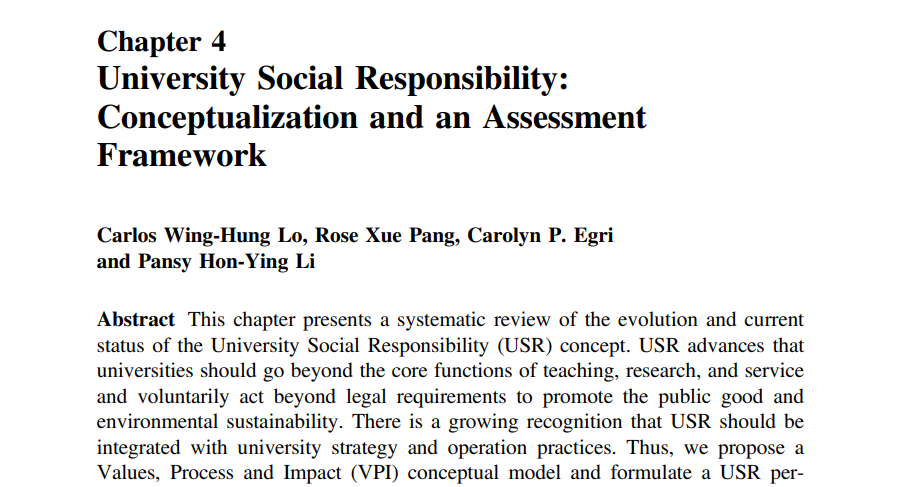
Lo, Carlos Wing-Hung, et al. “University social responsibility: Conceptualization and an assessment framework.” University social responsibility and quality of life: a global survey of concepts and experiences. Singapore: Springer Singapore, 2017. 37-59.
Research Design and Methodology
Selection Criteria for Index Constituent
Global USI
Comprised 113 universities selected from the top 150 of the QS World University Rankings 2024, with inclusion contingent on the availability of USR, SDG, and sustainability data in English or Chinese..
Asia-Pacific USI
Comprised 58 universities selected from the APRU (Association of Pacific Rim Universities) – 37 universities are also included in the Global or Greater China indices, while the remaining 21 are exclusively from Pacific Rim countries (e.g., Canada, Japan, South Korea, and Southeast Asian nations).
Greater China USI
Comprised 30 universities identified as the highest-ranked in their respective locations according to the QS rankings, including all 8 UGC-funded institutions in Hong Kong, 10 leading universities in Mainland China, 9 in Taiwan, and 3 in Macau.
The research team refined the Value–Process–Impact (VPI) framework to track institutions’ policy commitments, campus operations, community engagement, and research impacts.
The scoring is based on the 4 aspects under the VPI model, namely Value, Process (Management & Practice) and Impact, to assess University sustainability from all angles. The respective weight is as shown.
The USI assessment covers 109 indicators organised across 8 stakeholder categories. Each category draws on the Value–Process–Impact (VPI) framework: Governance indicators assess institutional values and management structures, while all other stakeholder categories are evaluated on both Practice (what universities do) and Impact (measurable outcomes). The table below summarises indicator distribution; expand any category to view the full indicator list.
| Stakeholder Category | VPI Dimensions Covered | Indicators |
|---|---|---|
| Governance | Value Process – Management | 9 |
| Students | Process – Practice Impact | 16 |
| Employees | Process – Practice Impact | 19 |
| Funding Bodies | Process – Practice Impact | 9 |
| Peer Universities | Process – Practice Impact | 10 |
| Community | Process – Practice Impact | 18 |
| Environment | Process – Practice Impact | 16 |
| Suppliers | Process – Practice Impact | 12 |
| Total | 109 |
Governance
9 indicators
USR / Sustainability Values
| Indicator | Description |
|---|---|
| Written USR/sustainability policy or statement | Existence of a written policy, vision, mission, strategy, code of conduct, or charter |
| Extent of the USR/sustainability statement | Level of detail: basic statement, descriptive, or including a conceptualisation |
| Stakeholders mentioned in USR/sustainability policy | Which stakeholder groups are explicitly referenced in the university's sustainability statement |
USR / Sustainability Management
| Indicator | Description |
|---|---|
| USR/sustainability goals | Whether formal goals exist and which stakeholders they cover |
| USR/sustainability strategic plans | Existence of strategic plans and their stakeholder scope |
| USR/sustainability programmes | Active programmes directed at specific stakeholder groups |
| USR/sustainability budget | Dedicated budget allocation for sustainability activities |
| Management structure for USR/sustainability | Formal committee, dedicated office, or senior management responsibility |
| Regular USR/sustainability reporting | Frequency and scope of published sustainability reports |
Students
16 indicators
Practice — Students
| Indicator | Description |
|---|---|
| Quality of education actions | Budget, student engagement, study support, career development, employment support, staffing quality |
| Equality and diversity advocacy | Fair admission, fair teaching/assessment, information transparency |
| Student welfare and wellbeing | Health, counselling, safe environment, study-life balance, family care, scholarships, disability access |
| Fostering students' social responsibility | Curriculum, extra-curricular activities, USR research, scholarships, student clubs |
| Appeal and complaints channels for students | Availability of ombudsperson or equivalent mechanisms for USR/sustainability issues |
| USR/sustainability communication with students | Formal and informal channels; communication frequency |
| Codes of conduct for students | Existence of student-facing USR/sustainability codes of conduct |
Impact — Students
| Indicator | Description |
|---|---|
| Awards and recognitions for student programmes | Local, national, and international recognition received |
| Student feedback rate | Percentage of positive student feedback (<40% / 40–80% / >80%) |
| Employment rate in USR/sustainability-related jobs | Share of graduates working in sustainability-related roles |
| Enrolment in USR/sustainability subjects | Percentage of students taking sustainability-related courses |
| Participation in USR/sustainability activities | Percentage of students involved in sustainability activities |
| Admission diversity statistics | Percentage of racial/ethnic minority groups in admissions |
| Student complaints trend | Trend in unsettled student complaints (increase / decrease / no change) |
| Students in sustainability exchange programmes | Number/percentage involved in sustainability-focused exchange or field trips |
| Graduation rate (normalised) | Percentage of students completing their degree (<80% / 80–95% / >95%) |
Employees
19 indicators
Practice — Employees
| Indicator | Description |
|---|---|
| Employee health and safety | Healthcare, counselling, safe workplace, work-life balance programmes |
| Workplace equity | Gender/racial equity in recruitment, job opportunities for disadvantaged groups, disability accommodation |
| Employee development and education | Training budget, career development, USR/sustainability promotion, research fund |
| Employee welfare | Healthcare benefits, pension, awards, family care, maximum working hours |
| Transparency in employment practices | Open information on recruitment, performance, salary, and management policies |
| USR/sustainability communication with employees | Formal and informal engagement mechanisms and frequency |
| Codes of conduct for employees | Existence of employee-facing USR/sustainability codes of conduct |
Impact — Employees
| Indicator | Description |
|---|---|
| Employee satisfaction level | Percentage reporting high or moderate satisfaction |
| Employee participation in voluntary sustainability activities | Share of employees involved in USR/sustainability volunteering |
| Staff turnover rate (normalised) | Annual turnover: <5% / 5–10% / >10% |
| Women in management/senior positions | Percentage of female employees in leadership roles |
| Ethnic minority representation in senior positions | Percentage of racial/ethnic minority groups in management |
| Training hours per employee per year | Average annual hours spent on development and education |
| Sustainability conference attendance per staff | Average number of sustainability-related conferences attended per staff member |
| Meetings with employee associations on sustainability | Number of formal engagement meetings with employee associations |
| Employees with disabilities | Number/percentage of staff members with disabilities |
| Workplace injuries | Occurrence of workplace injuries in the reporting year |
| Employees in sustainability-focused training | Share of employees engaged in sustainability training and development |
| Research projects/papers on sustainability | Percentage of research output with a sustainability focus |
Funding Bodies
9 indicators
Practice — Funding Bodies
| Indicator | Description |
|---|---|
| Regular communication with government/funding bodies | Frequency of meetings, information dissemination, and financial transparency |
| Regular financial audits | Frequency of external financial audits |
| Participation in government-sponsored programmes | Social, philanthropy, environmental, education, and research programmes |
| Provision of government-sponsored programmes | University-delivered programmes sponsored by government/funding bodies |
| Advocacy of USR/sustainability to policy makers | Initiatives influencing business, social, environmental, and education policy |
Impact — Funding Bodies
| Indicator | Description |
|---|---|
| Meetings with government/funding bodies on sustainability | Number of formal sustainability meetings with funders |
| Management reports to government/funding bodies | Number of sustainability reports submitted to funders |
| Sustainability initiatives supported by funders | Number of initiatives co-supported with government/funding bodies |
| Sustainability policy proposals to funders | Number of policy initiatives proposed to government or funding bodies |
Peer Universities
10 indicators
Practice — Peer Universities
| Indicator | Description |
|---|---|
| Fair competition practices | Fair conduct in student admission, staff recruitment, research, and education |
| Joint USR/sustainability initiatives | Collaborative social, environmental, research, and education programmes |
| Communication and engagement with peer universities | Formal and informal channels and frequency of engagement |
Impact — Peer Universities
| Indicator | Description |
|---|---|
| Experience sharing on sustainability | Whether experience-sharing on USR/sustainability takes place with peers |
| Attendance at joint sustainability conferences | Number of joint conferences or seminars attended with peer institutions |
| Joint sustainability classes | Existence of co-taught sustainability courses with peer universities |
| Sustainability-focused exchange programmes | Exchange programmes with an explicit sustainability focus |
| Joint education programmes on sustainability | Enrolment in shared sustainability education programmes |
| Joint sustainability initiatives | Number of collaborative sustainability projects with peers |
| Joint social projects with peers | Number of joint social responsibility projects |
Community
18 indicators
Practice — Communities
| Indicator | Description |
|---|---|
| University philanthropy to communities | Frequency and nature of philanthropic activities |
| Support for local employment | Preference for local hires, people with disabilities, immigrants, veterans, ethnic minorities |
| Voluntary USR/sustainability service | Volunteering, environmental protection, and care for disadvantaged groups |
| Sponsorship of USR/sustainability activities | Sponsorship of social responsibility and environmental protection activities |
| Communication and engagement with communities | Formal and informal mechanisms and their frequency |
| Joint initiatives with communities | Social, environmental, research, and education collaborative projects |
Impact — Community
| Indicator | Description |
|---|---|
| Number of donations to communities | Monetary and in-kind donations made in the reporting year |
| Community projects supported | Total number of community projects the university supported |
| Long-term community projects (3+ years) | Number of ongoing projects sustained for three or more years |
| Community projects with NGOs | Jointly organised projects with non-governmental organisations |
| Community projects with businesses | Jointly organised projects with the business community |
| Staff participation in community services | Percentage of staff engaged in community sustainability services |
| Staff hours in community sustainability services | Average hours per employee per year in community service |
| Media coverage of community activities | Number of media reports about the university's community sustainability work |
| Community complaints on sustainability | Presence of complaints from the community regarding sustainability |
| Business information sessions on sustainability | Sessions sharing and promoting sustainability with the business community |
| Knowledge transfer projects to business community | Projects involving sustainability knowledge transfer to businesses |
| Business endowments for sustainability | Number of endowments from the business community for sustainability programmes |
Environment
16 indicators
Practice — Environment
| Indicator | Description |
|---|---|
| Environmental management policies | Existence of formal environmental management policies |
| Environmental management system | Establishment of a formal environmental management system |
| Environmental monitoring systems | Systems for ongoing environmental performance monitoring |
| Environmental performance indicators tracked | Energy, water, waste, emissions, biodiversity, and other metrics actively measured |
| Communication on environmental practices | Mechanisms for sharing environmental performance with stakeholders |
Impact — Environment
| Indicator | Description |
|---|---|
| Energy consumption reduction | Percentage change in energy use compared to previous year |
| Water consumption reduction | Percentage change in water use compared to previous year |
| Indoor air quality | Whether indoor air quality has improved |
| Recycling rate | Current recycling rate (0% / 0–20% / 20–40% / >40%) |
| Reduction of solid waste to landfills | Percentage decrease in landfill-bound solid waste |
| Reduction of hazardous waste disposal | Percentage decrease in hazardous waste disposal |
| Environmental programmes organised/sponsored | Number of environmental programmes run or supported |
| ENGO collaborations | Number of collaborations with environmental NGOs |
| GHG emissions reduction | Percentage reduction in greenhouse gas emissions year-on-year |
| Increase in greenery areas | Whether campus green space as a share of total area has grown |
| Complaints related to environment and pollution | Presence of environmental or pollution-related complaints |
Suppliers
12 indicators
Practice — Suppliers
| Indicator | Description |
|---|---|
| USR/sustainability criteria in procurement | Application of sustainability standards in supplier selection and contracts |
| Supplier USR/sustainability policy | Formal written policy governing supplier sustainability conduct |
| Monitoring supplier sustainability performance | Audits, inspections, and submission of CSR/sustainability information by suppliers |
| Communication mechanisms with suppliers | Frequency of calls, site visits, meetings, online communication, and feedback |
| Materiality of supplier engagement | Nature and significance of sustainability engagement with suppliers |
Impact — Suppliers
| Indicator | Description |
|---|---|
| Local supplier share | Percentage of suppliers that are local (<50% / 50–80% / >80%) |
| Long-term supplier share (3+ years) | Percentage of suppliers with relationships of 3 or more years |
| Meetings and inspections with suppliers | Number of monitoring interactions with suppliers in the year |
| Suppliers with SER collaboration | Percentage of suppliers engaged in social/environmental responsibility work |
| Complaints about suppliers | Number of complaints about suppliers lodged by students or employees |
| Complaints from suppliers | Number of complaints received from suppliers |
| Supplier violations of regulations/contracts | Number of documented supplier violations |
The index universities are categorized into 6 tiers based on the scores attained, with each tier representing the level of achievement in their sustainability journey.
| USI Score | Tier |
| 90 – 100 |  |
| 80 – 89 |  |
| 70 – 79 |  |
| 60 – 69 |  |
| 50 – 59 |  |
| Below 50 |  |

Reports
Advisory Committee
Advisors

Professor Carolyn Egri
William J.A. Rowe EMBA Alumni Professor, Beedie School of Business, Simon Fraser University

Professor Sasha Maher
Department of Management, Society and Communication, Copenhagen Business School

Professor Xue Pang
Faculty of Business, City University of Macau
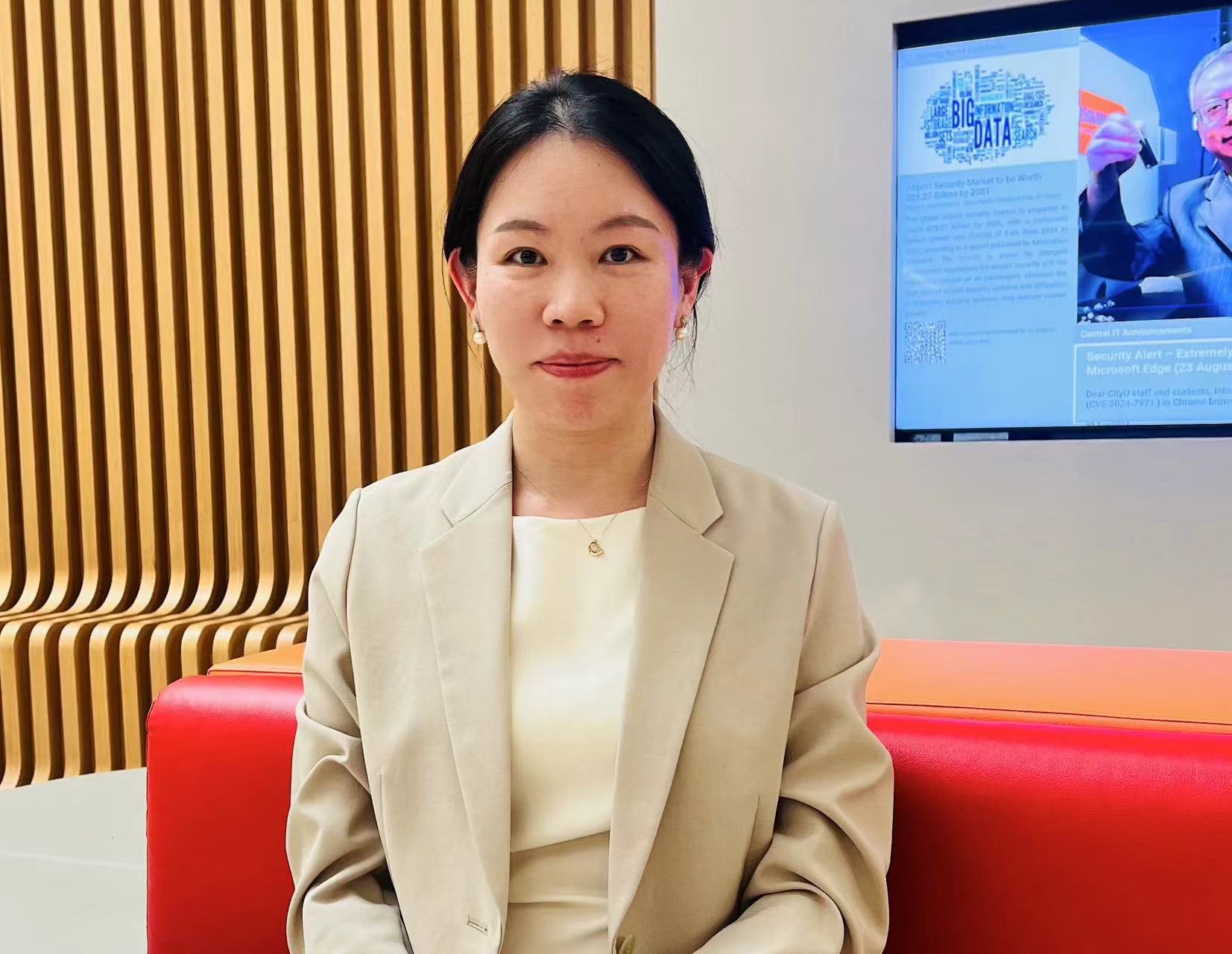
Professor Ning Liu
Department of Public and International Affairs, City University of Hong Kong

Professor Chenyang He
HeXie Management Research Centre, Xi’an Jiaotong-Liverpool University

Dr. Jingwen Mu
Office of Institutional Research and Strategic Planning, Hong Kong Baptist University

Professor Min-Fen Tu
Department of Business Administration, Tamkang University
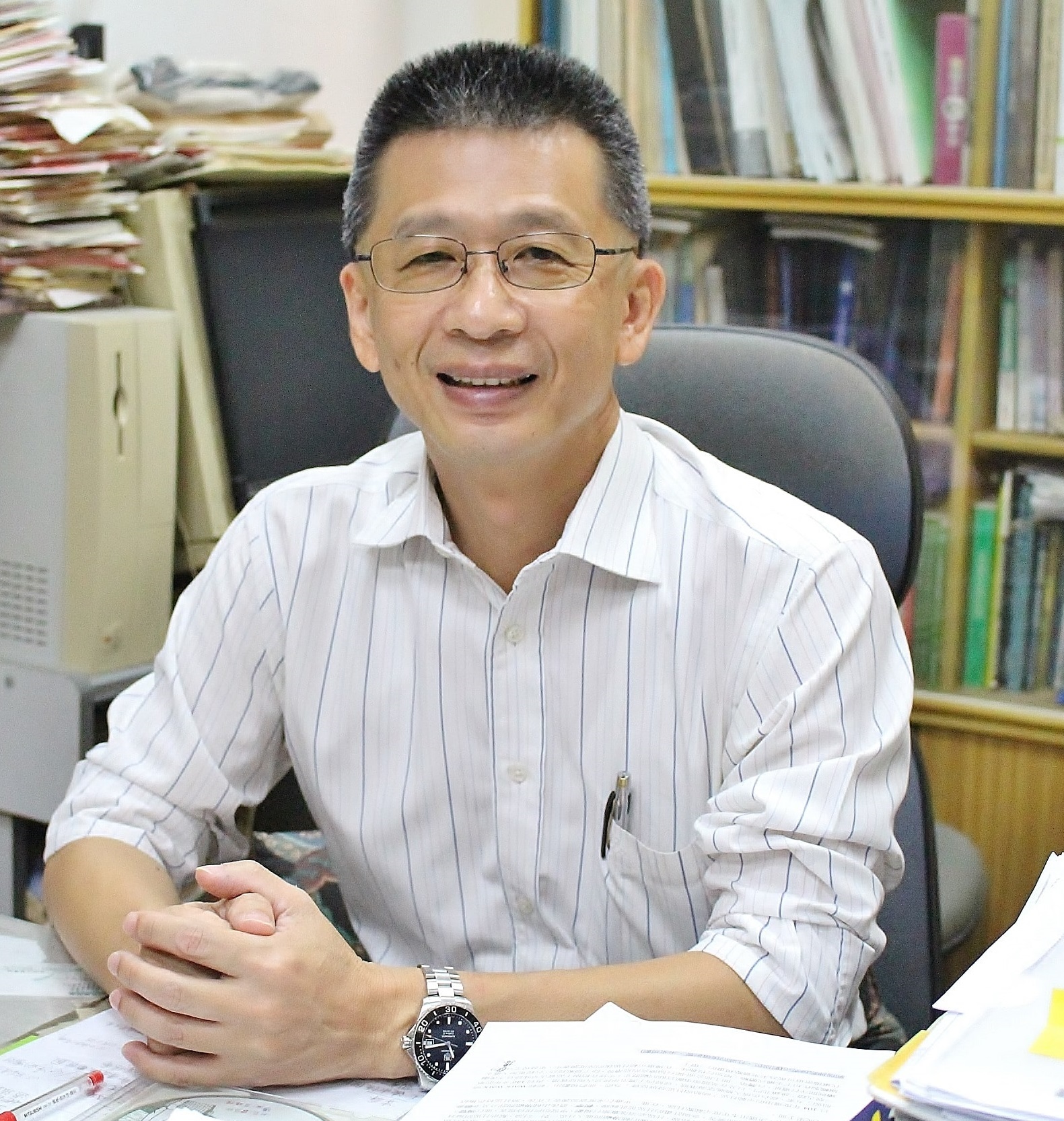
Professor Jui-Kun Kuo
Institute of Public Affairs Management, National Sun Yat-sen University

Dr. Nahid Yazdani
Business School, University of Nottingham

Professor Paulina Wong
Division of Science, Lingnan University Hong Kong
Voices
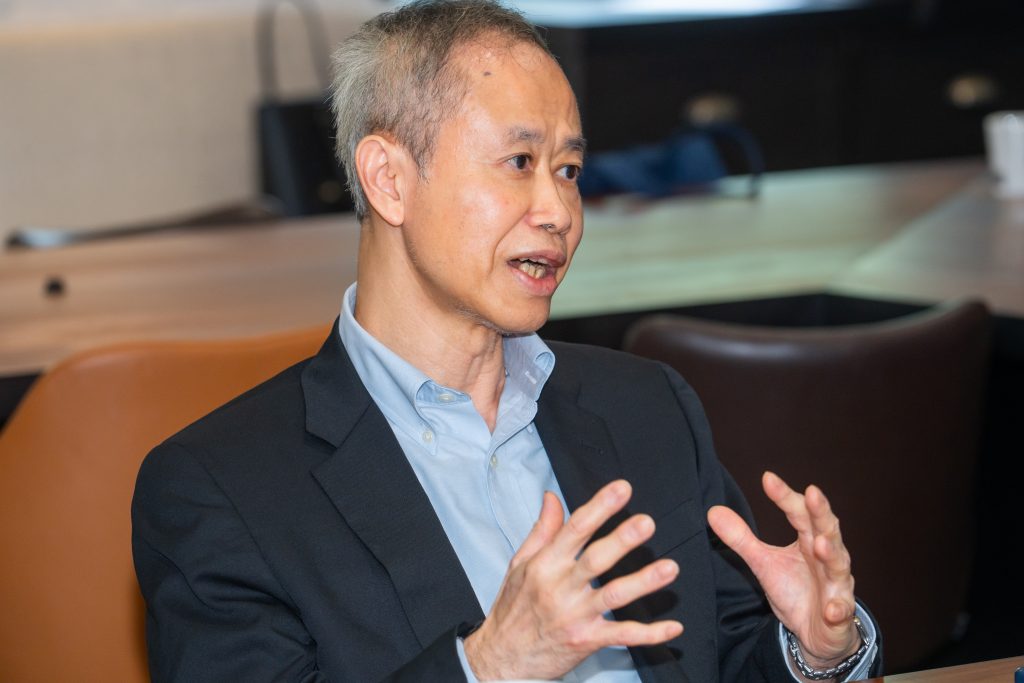
Dr. Nahid Yazdani, Assistant Professor in Global Business Operations, University of Nottingham
Universities have an important role not only in advancing knowledge about sustainability, but in demonstrating it through the way they teach, research, govern and operate. I see the USI as a valuable opportunity to encourage universities to reflect on this broader responsibility and, importantly, on the difference between having sustainability commitments and demonstrating meaningful outcomes. I hope the Index will continue to foster constructive dialogue and mutual learning, helping universities move from aspiration and activity towards measurable and lasting societal impact.
Professor Alex Wai, President and Vice-Chancellor, Hong Kong Baptist University
The Research, Education and Social Responsibility Imperative
In today’s interconnected world, universities hold a unique responsibility: to educate future generations while generating knowledge that advances academic frontiers and addresses society’s most pressing challenges. At Hong Kong Baptist University, education, research, and social responsibility are mutually reinforcing pillars of institutional excellence.
Research drives innovation, informs policy, and equips future leaders with the tools to navigate complex global issues. Yet, knowledge alone is not enough. True impact emerges when research is guided by a commitment to societal good. This is when scholarship directly contributes to health, education, sustainability, and equity. It is the essence of social responsibility: ensuring that what we discover serves communities locally, regionally, and globally.
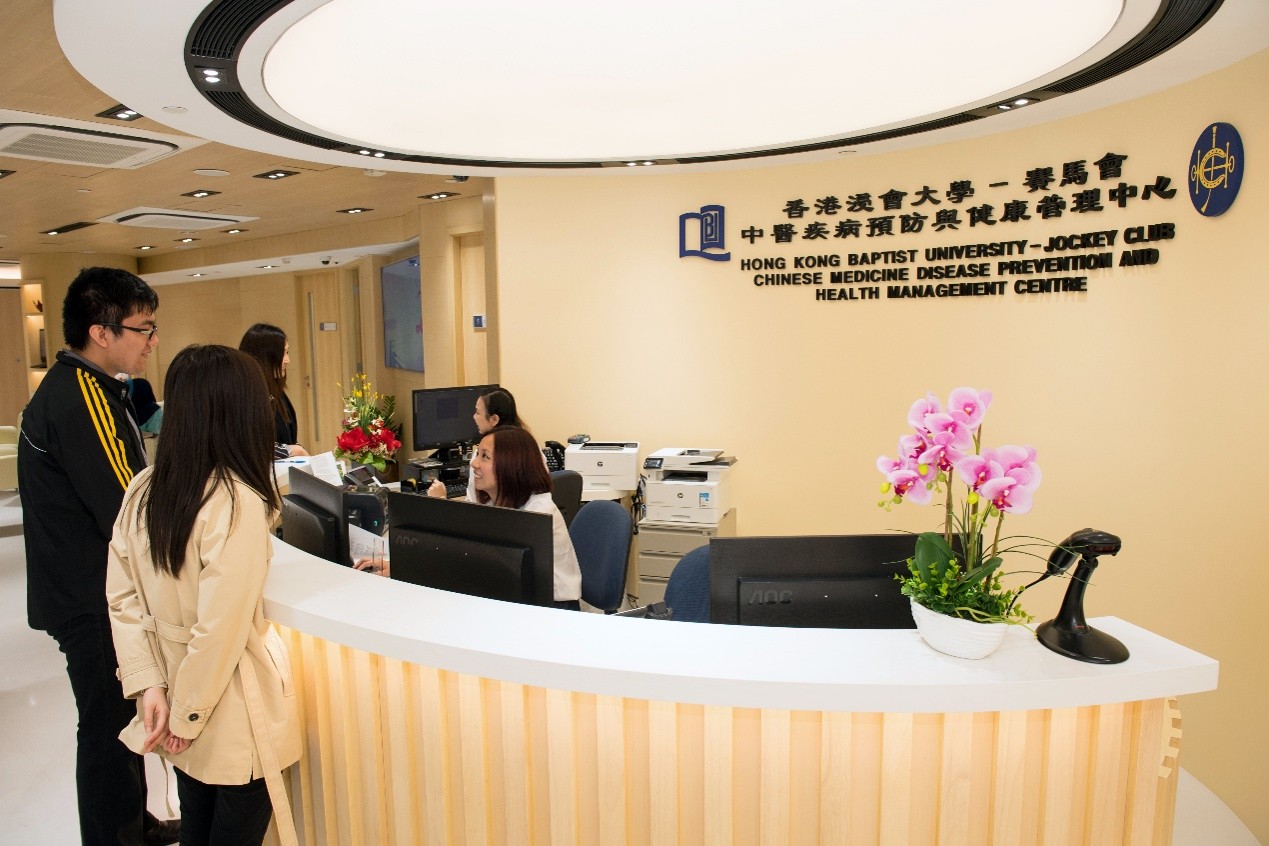
Our case study in Chinese Medicine in Communities highlights the critical role of universities in establishing the academic foundations of a discipline that already holds deep cultural, clinical, and educational significance for our local communities. The transparency of this work and its global applications have been undertaken in the spirit of social good, global responsibility, and partnership.
Today, the culture of academic excellence we foster must also be paired with ethical responsibility, in which transdisciplinary collaborations extend beyond academia to include industry, government, and community partners, and in which every researcher understands the broader implications of their work. By aligning education and research initiatives with the United Nations Sustainable Development Goals, especially SDG 4 on quality education, HKBU is preparing scholars and socially conscious global citizens for our sustainably challenged world.
Dr. Jingwen Mu, Director of Institutional Research and Strategic Planning, Hong Kong Baptist University
Participating in the first University Sustainability Index has been both affirming and instructive. The VPI framework crystallises a challenge many of us face: translating well-articulated sustainability values and robust management systems into measurable, long-term impact for our stakeholders. HKBU’s Model Achiever result is encouraging, yet the persistent gap between Practice and Impact reminds us that the real work of university social responsibility lies in sustained programmes, transparent data governance, and genuine accountability to the communities we serve. I look forward to contributing to the collective learning that the USI seeks to foster.
Case Sharing
Sharing practical and academic insights

Interested in Sharing Insight or Best Practice?

University Social Case Contribution Guideline
We invite contributors to prepare a comprehensive case study that highlights sustainability practices and experiences. Please follow the guidance below to ensure consistency and clarity across submissions.
- Length and Format
- An extended piece of writing of approximately 5–8 pages, including 4–6 relevant pictures.
- Please provide the author(s) information, including name, position, and department/office. You may also specify the team’s name if applicable.
- Suggested Structure
- Program/Project Introduction
-
- Provide background and context for the initiative.
- Organization and Implementation
-
- Specify the organization(s) involved.
- Describe the implementation process in detail.
- Strategy, Objectives and Actions
-
- Outline the project’s strategy and objectives.
- Highlight actions taken, related stakeholders, and connections to relevant Sustainable Development Goals (SDGs).
- Outcomes
-
- Present the results achieved.
- Include changes observed among stakeholders, key achievements, awards, or recognitions.
- Strategic Vision for the Future
-
- Share the long-term vision and aspirations for the project.
- Project Sustainability and Experience Sharing
- Elaborate on the sustainability of the project.
- Discuss its potential for replication or implementation in other institutions.
- Reference Example
You may want to refer to the format and style: https://www.sdgfund.org/case-study/better-water-and-sanitation-services-through-consumer-rights-based-contract-albania
- Citation
Please use Harvard-style referencing where appropriate.